April 18 – June 24, 2024
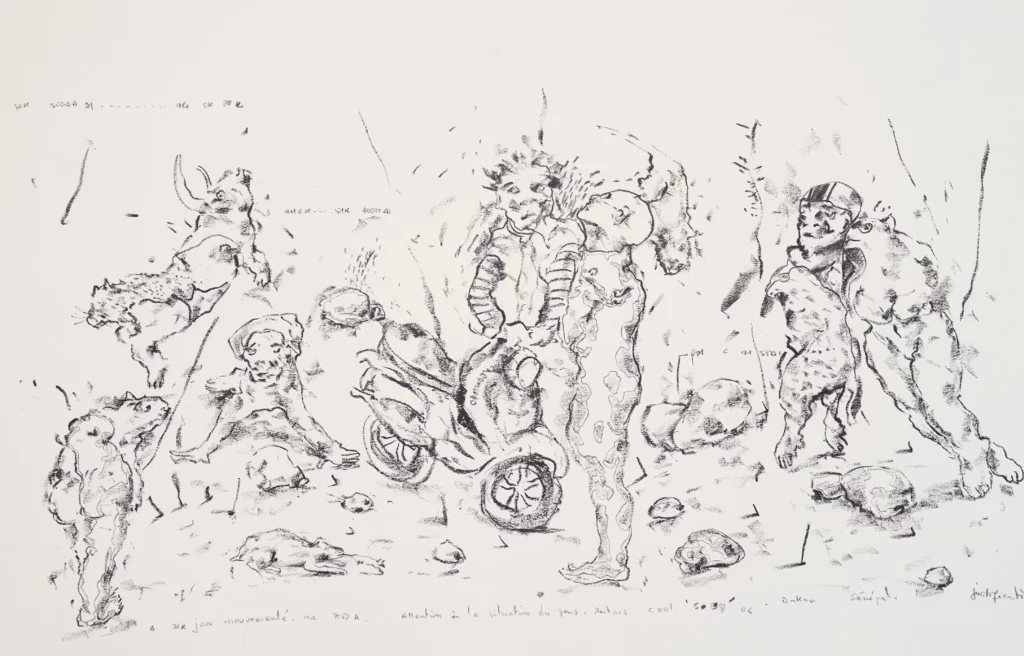
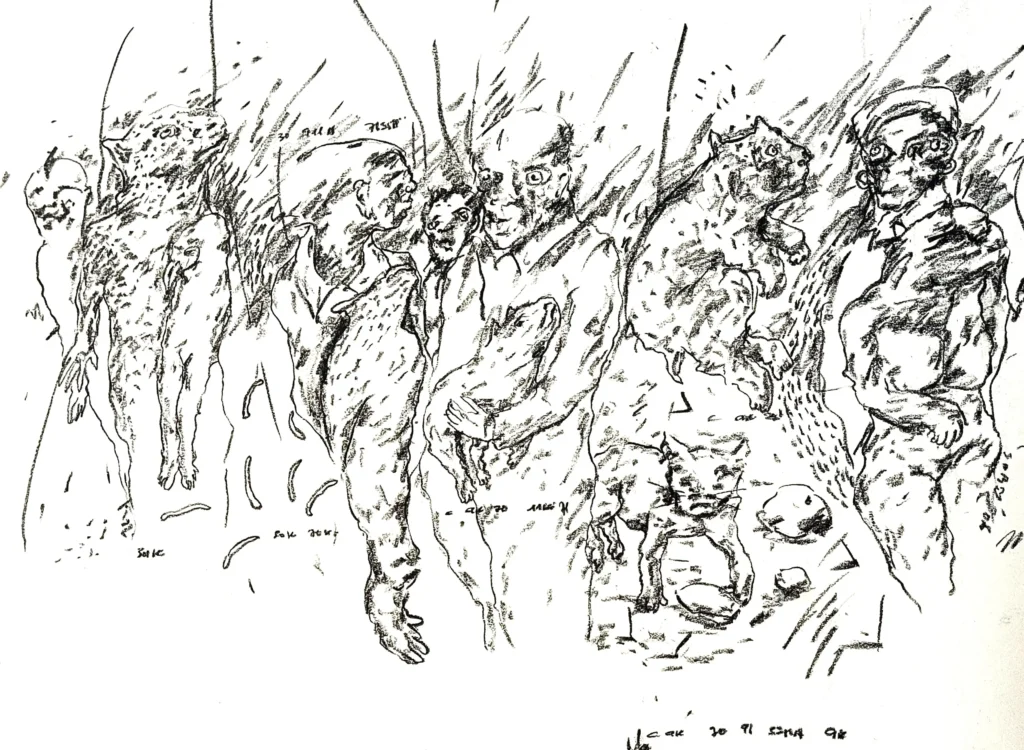
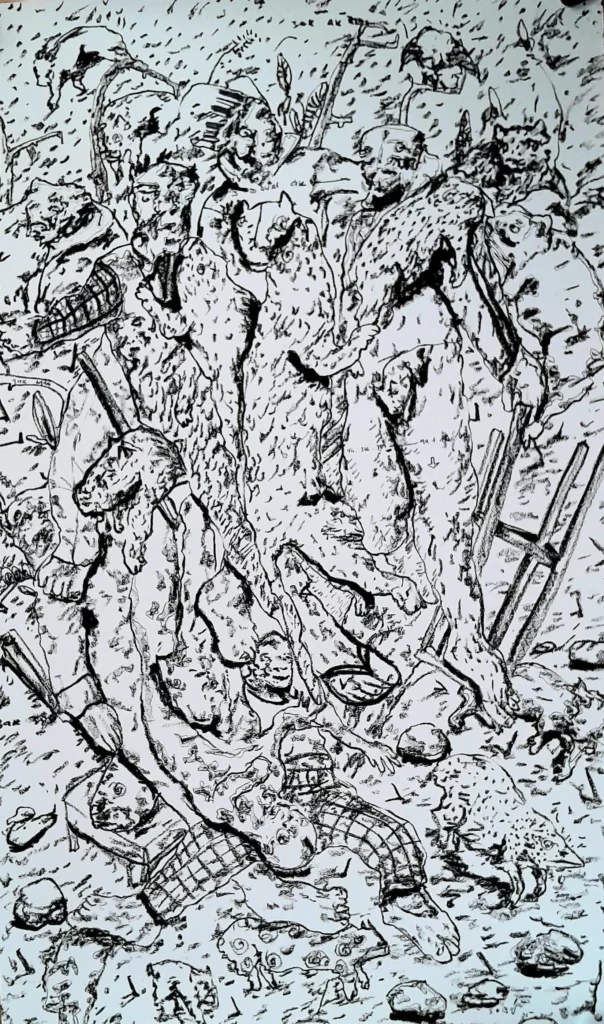
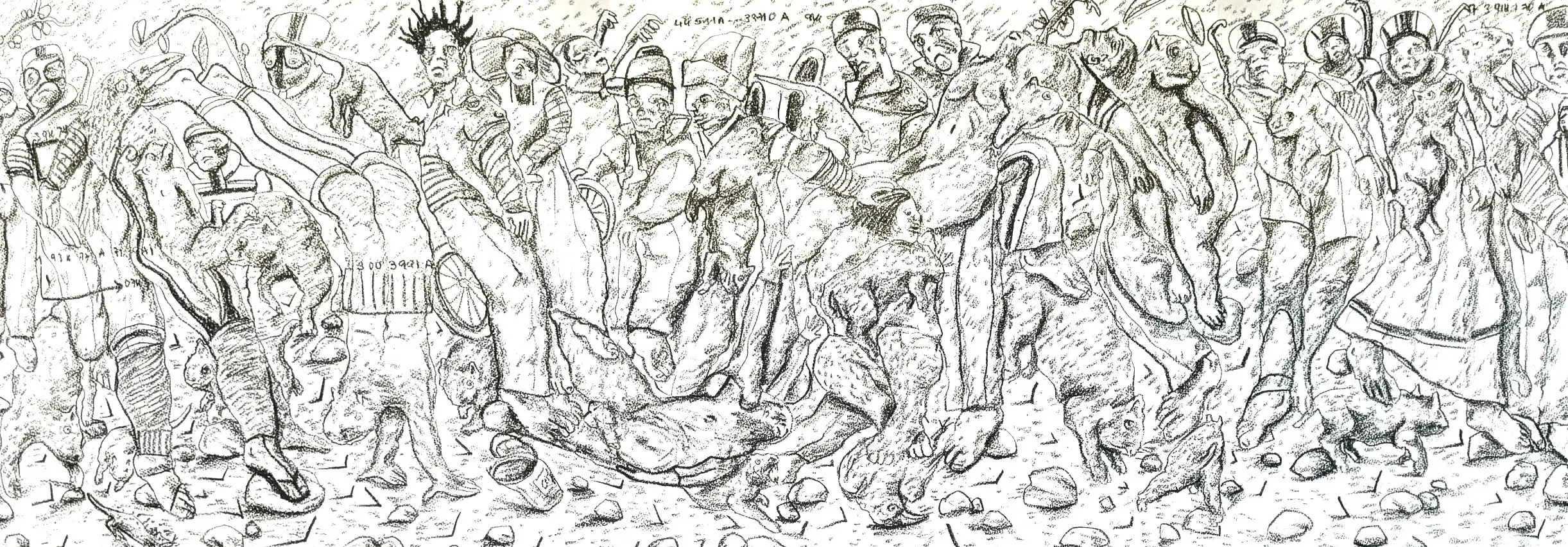
The gallery’s exhibition brings together a rare collection of charcoal drawings, created between 1999 and 2006, from the iconic series *Le Monde Perdu*,
which Soly Cissé began in 1996.
As early as 1996, long before the title became a cultural cliché, Soly Cissé named a series of graphic works “Monde Perdu” (Lost World). Originally, he had titled it with biting irony: “Cohabitation.”
For this “Monde Perdu,” linked to tales of fantastical journeys, is anything but a preserved paradise. Conan Doyle’s The Lost World (1912) and Michael Crichton’s The Lost World—which inspired Spielberg’s film Jurassic Park (late 1997)—draw us into worlds that are sometimes paradisiacal but often nightmarish, stuck at an earlier stage of evolution. A raw, primitive savagery—such as Goya depicted in 1814—pits indigenous peoples, dinosaurs, and ape-men—an entire prehistoric fauna—against one another in bloody battles within a world that is symbolically timeless.
With this visionary work, created long before the era of blockbusters, Soly Cissé finds a modern echo of primal savagery in a reflection on a “Lost World” that is both a nostalgia for a mythical age of harmony and a confrontation with the brutality of our origins.
.
One is struck by the dazzling intensity of the artist’s brushwork as he “tears” his figures from charcoal or red chalk in tangles of overlapping lines, like cave frescoes emerging from a suspended moment in time. One is reminded of the upheavals of extinct cultures… Lascaux… Altamira… the birth of art… vanished cults… the dawn of humanity.
.
.In 2001, art critic and historian Bruno Corà discovered Soly Cissé’s graphic work, *The Lost World*, in Dakar. He immediately highlighted its transcultural dimension and complexity, describing these charcoal drawings as a “wonderful pictorial invention” that explores themes that are both mythological and anthropological. For him, *The Lost World* is part of a tradition of universal allegories, echoing humanity’s great struggles. The art historian draws a parallel with Goya’s *Los Caprichos*, which he considers the only Western precedent due to its graphic density, placing the artist within a lineage marked by a dramatic and socially engaged vision of humanity.
.
In 2005, the *Monde Perdu* series was highlighted by Philippe Dagen in an article in *Le Monde*, on the occasion of the *Africa Remix* exhibition—organized by Simon Njami and Laurence Bertrand Dorléac—presented at the Centre Pompidou, following stops at the Kunstpalast in Düsseldorf and the Hayward Gallery in London. The art historian and critic emphasizes: The impact of Soly Cissé’s work lies in his ability to combine highly distinctive forms with universal themes, while offering a new perspective on contemporary artistic production. (The charcoal drawings from Soly Cissé’s *Monde Perdu* series, *Africa Remix*, singularities and universal forms, Philippe Dagen, *Le Monde*, May 25, 2005.
In 2022, a collection of the artist’s graphic works, along with several of his paintings, was acquired by the Centre Pompidou in Paris,
affirming the institutional recognition of his work.
.
Bruno Corà is currently the director of the Alberto Burri collection in the province of Perugia, Italy.