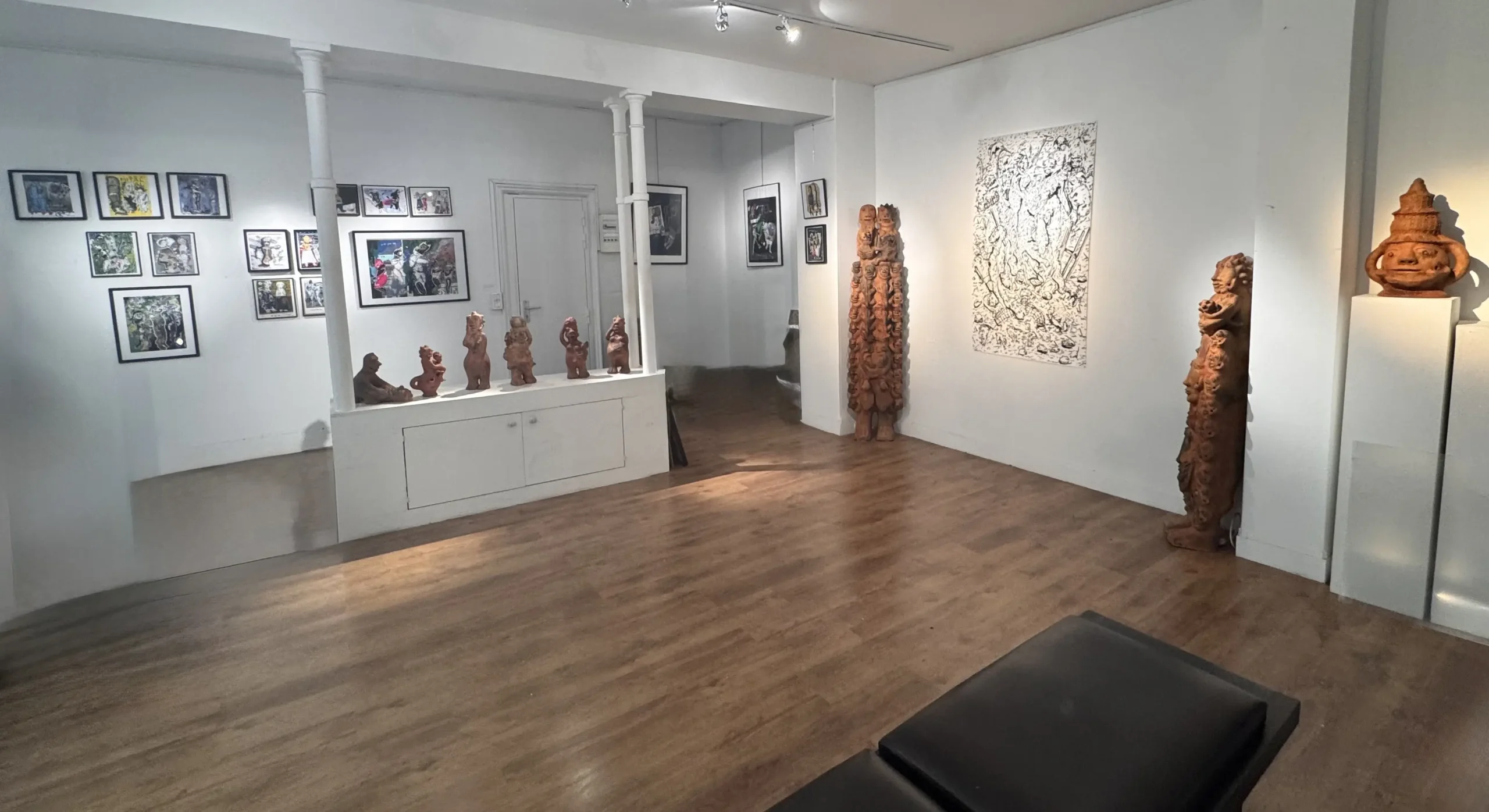
Soly CISSE-Confiance-2005-81 x 117 cm

DRAWINGS OUTSIDE THE LINES, SOLY CISSE

03/02/2026

15/03/2026

« Drawings outside the lines », Masterpieces from the Centre Pompidou’s Collection

Associated programme
Drawings Trail through Parisian Art Galleries
.

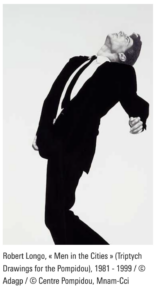
Robert Longo collection Centre Pompidou

With over 35,000 drawings, the Centre Pompidou’s graphic art collection is one of the world’s largest collections. For the first time, more than 300 works by 120 artists including Dubuffet, Basquiat, Delaunay, Kentridge and many others reveal, at the Grand Palais, a constantly reinvented art of drawing.
.

.

SOLY CISSÉ, DRAWINGS OUTSIDE THE LINES

February 3 ➜ March 15, 2026
.

Press release  read or download in English
lire ou télécharger en Français

.

Soly Cissé explores paper as a field of multiple experimentations, where collage, cut-outs, imprints, calligraphy, and interwoven signs intersect. The artist distributes symbols and images in sanguine, charcoal, or oil pastel, with a quick brush that bind the temporality of gesture to that of reading.
.
.

Words, signs, pictograms, and figurative elements
.

.
Deeply marked by a childhood spent in a hunters’ village near the Bafing River in Mali—a milieu governed by social conventions akin to secret myths—Soly Cissé populates his works with humans, animals, plants, and spirits, linked by invisible interdependencies.
.
At the heart of a plural totemic universe, blending secret myths and cosmologies, the artist feeds his drawings (or canvases) with signs, illegible scripts, diagrams, and barcodes that do not yield immediate meaning, except perhaps for the irony and humor inherent in rebuses.
At times, format becomes a central issue: a word takes on a determining role, or heterogeneous materials—collage fragments, newspaper integrated without alteration, like a ready-made within the fluidity of the paint—come to blur the scene unfolding within
..
So many incoherent signs, carried by the speed of the gesture, generate a race of the eye looking for across the clues in the image. By subverting a focal point and asserting the flatness of canvas or paper, Soly Cissé places the viewer at the center of an open interpretative game, revealing the interweaving of space and time within the work.
.
.
Soly Cissé_D-Codages, 2004 -
Soly Cissé_D-Codages, 2004 –
.
.

In the mid-1990s, Soly Cissé began the “Lost World” cycle.
.

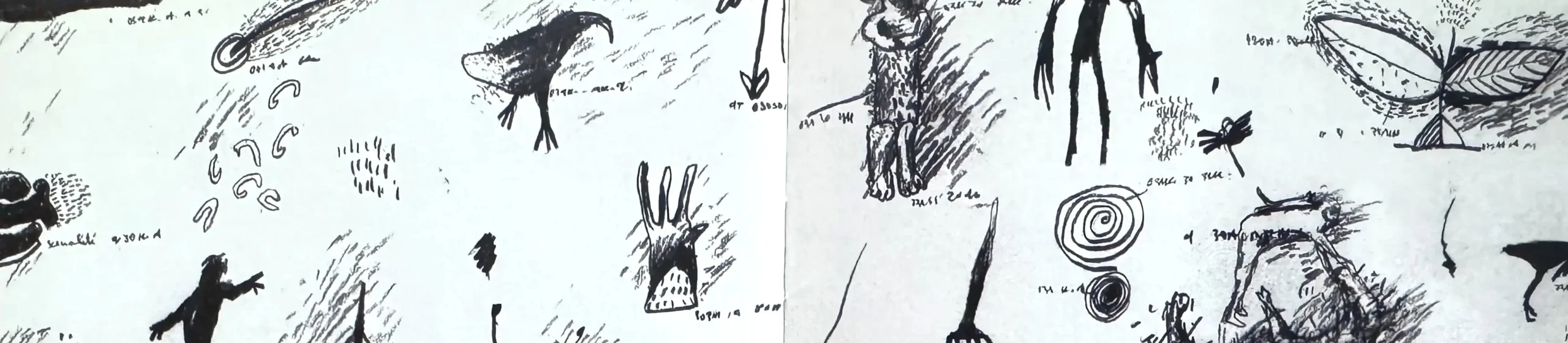
The presentation brings together a group of charcoal drawings made between 1999 and 2006, drawn from the emblematic series Le Monde Perdu (The Lost World), initiated by Soly Cissé as early as 1996.
One feels a shock at the immediacy of the artist’s gesture, which “tears” his figures from charcoal or sanguine through entangled, superimposed lines, like cave frescoes emerging from suspended time.
.
These figures evoke the upheavals of vanished cultures: Lascaux, Altamira… the birth of art, missing cults, the dawn of humanity; as well as the striking opening scene of 2001: A Space Odyssey (1968) by Stanley Kubrick, set to Richard Strauss’s «  »Thus spoke Zarathustra », or the Lost Worlds of Jurassic Park (adapted by Spielberg from Michael Crichton’s novels, themselves a homage to Conan Doyle’s novella The Lost World, 1912)

.
.

Between archaeology and science fiction, the Lost Worlds traverse the 20th century as a metaphor—like a parable—of the Human Condition. Beyond past, present, and coming soon struggles, the artist grants his faceless, identity-less figures a universal character.
.
.

COLLAGES
CUTTING, FRAMING, MONTAGE
.

DESSIN SANS LIMITE SOLY CISSE

.

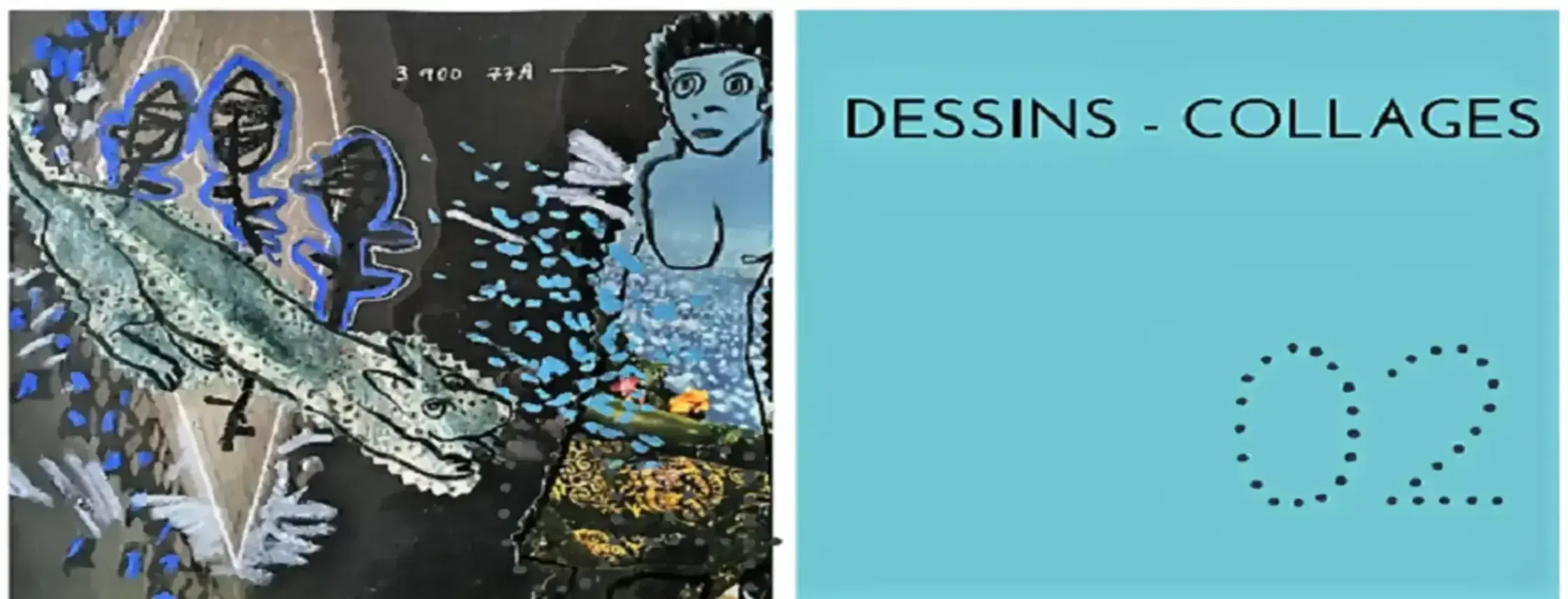
The entire aesthetic of the artist’s collages stems from a cinematic framing inspired by his early interest in comics. To the act of reappropriation inherent in gluing is added a precise choice of support: pages from Western art magazines. From this cutting into the pages of an art magazine—reintegrating several elements with no relation to one another—emerges the shock of montage. Of a single magazine format (210 × 297 mm), “small containers with vast contents¹,” these collages stage playful yet unsettling figures.
.
A challenge and an artistic gesture that overturns the status of the printed image, transforming it into an original work.
.
“WE TOO HAVE THE RIGHT TO BE IN THIS HISTORY,” the artist declares to Roxana Azimi, who interviewed him in 2016 for Le Monde.
“I take images from art magazines and draw over them to impose my own universe. It’s a way of appearing on those pages, within that history.
.
..

Critical and Institutional Recognition
.

In 2001, art critic and historian Bruno Corà discovered this major body of graphic work in Dakar. He immediately emphasized its transcultural dimension and complexity, describing these charcoal drawings as a “fortunate pictorial invention” exploring themes that are both mythological and anthropological.
For him, The Lost World belongs to a tradition of universal allegories, echoing the great struggles of humanity. Bruno Corà draws a parallel with « Goya’s Caprichos », which he considers the only Western precedent for their graphic density, thus placing Soly Cissé within a lineage marked by a dramatic and committed vision of humanity.
.
In 2005, the Lost World series was brought to wider attention by Philippe Dagen in an article published in Le Monde, on the occasion of the exhibition Africa Remix—organized by Simon Njami and Laurence Bertrand Dorléac—presented at the Centre Pompidou after touring the Kunstpalast in Düsseldorf and the Hayward Gallery in London.
The art historian and critic noted: « The impact of Soly Cissé’s work lies in its ability to combine highly singular forms with universal concerns, while offering a new perspective on contemporary artistic production ».
The charcoals of Soly Cissé’s Lost World series, Africa Remix, singularities and universal forms,” Philippe Dagen, Le Monde, 25 May 2005
..
In 2022, a group of graphic works as well as several paintings by the artist were acquired by the Centre Pompidou, Paris, affirming the institutional recognition of Soly Cissé’s work


Artistes

Aucun artiste lié à cette exposition.